
Preston has been in the middle of a quiet but very real transformation for the better part of a decade. The suburb that Courtney Barnett immortalised as “Depreston” in 2015 — affordable, a little rough around the edges, full of potential — has matured into something else entirely. The Victorian weatherboard cottages on the side streets west of High Street, the post-war brick bungalows in the mid-suburb grid, the terrace rows near Bell Street: all of them have attracted buyers who saw the suburb’s bones and decided to invest in what it could be.
The result is a Preston full of renovations in progress and recently completed. Kitchens ripped out and replaced. Rear extensions pushing into back yards to create family rooms and new decks. Bathrooms modernised. Front facades freshened up. It’s a suburb genuinely mid-transformation, and the renovation work is visible on almost every block.
And in almost all of those renovations, the locks are the last thing anyone thinks about.
Why Renovation Creates a Security Gap
A Preston home renovation is a period of managed disruption: trades coming and going for weeks or months, a builder’s project key in circulation, site access maintained across the working week for plumbers, sparkies, tilers, concreters, and plasterers. During this period, keys are cut, shared, used, and sometimes not returned.
By the time practical completion is reached and you’re back in a finished home, the key history of that renovation period is genuinely unclear. The builder holds a set until handover. Subcontractors may have been given individual keys for access when the builder wasn’t on site. A real estate agent who valued the property mid-reno might have held a set briefly. The number of copies cut and circulated across a six-month renovation project on a Preston cottage is not formally tracked by anyone.
The renovation itself also creates a specific window of vulnerability: a home under renovation is often partially occupied or empty, and the temporary doors and boarding used during construction are not the security standard of the finished building. A home that’s been comprehensively renovated should, on completion, have its lock situation reset to match.
This is the moment — the first week after practical completion — where a rekeying is most valuable. All locks on the finished property rekeyed to a new key profile, only the keys provided to the owner at handover operative, the entire renovation key history closed off.
Pro Tip: Build the post-renovation rekey into the final week of your project budget before works begin — it’s a modest cost relative to the renovation spend, and it’s far more likely to happen if it’s a scheduled line item than an afterthought once you’ve moved back in.
The Builder’s Standard Lock Problem
Many Preston renovation projects involve either new external doors (as part of a facade refresh or structural change) or replacement of the existing hardware as a cosmetic element. In both cases, the lock on that new door is typically supplied from the builder’s standard hardware package — a mid-range or economy deadlock that comes with the door or from the hardware wholesaler the building company uses.
The builder’s standard lock is rarely the right lock for a Preston home at current values. Preston’s median house price sits around $1 million; the median for a four-bedroom home is above $1.3 million. The hardware on the entry points of a property at that price should reflect the value being protected.
Builder-standard locks in Melbourne typically sit at Grade 3 or 4 on the AS 4145 lock standard — functional for keeping a door closed, but not rated to the resistance levels appropriate for a residential external entry. Grade 5 or Grade 6 deadlocks — the appropriate specification for an external residential door in a suburb with Preston’s property crime rate — cost more, but not dramatically more, and they’re not a premium purchase relative to what they protect.
The cylinder is a separate question. Builder-standard cylinders use a non-restricted keyway — any key kiosk in a Preston supermarket or hardware store can cut a copy. A restricted-keyway cylinder, managed through a licensed locksmith, means copies can only be made by the registered system holder with written authorisation. For a post-renovation rekey, upgrading to a restricted-keyway cylinder at the same time costs a small additional amount and provides key control that lasts for the life of the hardware.
The Sliding Door: Every Preston Rear Extension Has One
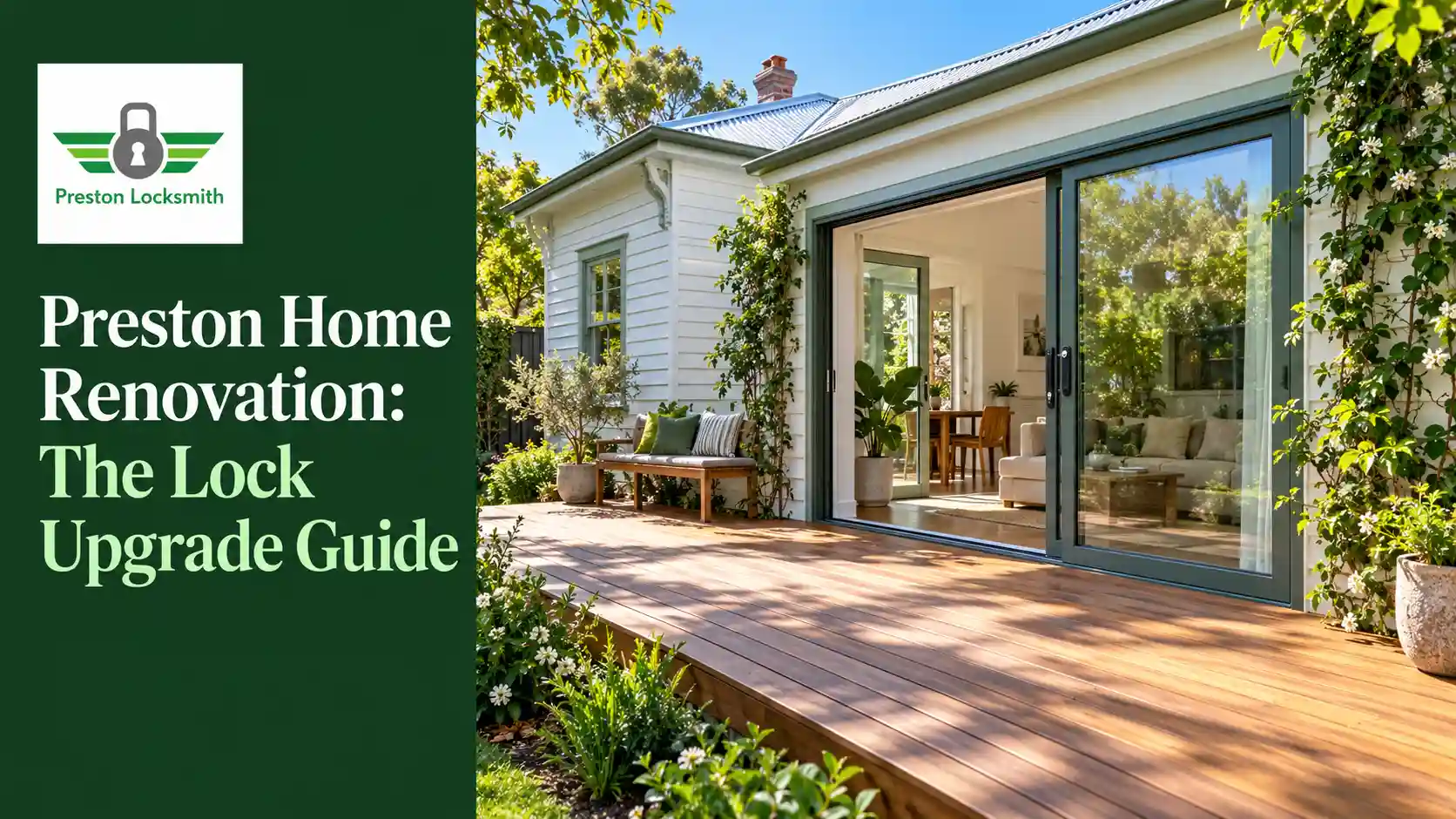
Preston’s residential renovation boom has produced a consistent output: a rear extension with a large sliding glass door onto a deck or courtyard. This combination — rear extension, sliding door, new outdoor area — is the standard outcome of a Preston cottage or brick home renovation in the 2010s and 2020s.
The sliding door that comes as part of a builder’s rear extension package is almost always a security concern. The face-lever latch that holds the panel closed is not a security lock. It keeps the door shut against wind and accidental opening; it does not provide meaningful resistance to forced entry. On most builder-standard sliding doors, the face latch can be bypassed by inserting a thin tool between the door panels and disengaging the mechanism, or by lifting the panel out of the bottom track if no anti-lift mechanism has been fitted.
Two upgrades convert a builder-standard sliding door to a properly secured one: an anti-lift block or pin in the top track channel (preventing the panel being lifted free), and a secondary lock — either a key-operated track bolt or a security bar — that provides real resistance to horizontal forcing. Both can be fitted in under an hour on a standard aluminium sliding door.
If your Preston renovation included a rear extension with a sliding door, and that door received only the builder’s standard hardware, these two items are the highest-priority security gap on the finished property.
Period Hardware in Preston’s Older Homes
Preston’s Victorian and Edwardian weatherboard cottages — the side streets west of High Street, around Bruce Street and Gilbert Road — have a different security challenge. These properties often have original or near-original mortice lock hardware: a pressed-steel or cast-iron lock case in the door, operated by a large-barrel key, sometimes with a separate surface-mounted deadbolt added at some point over the previous thirty or forty years.
A renovation that modernises the kitchen, bathrooms and living areas of a Preston cottage while leaving the original mortice lock on the front door has a specific problem: the original lock hardware, after eighty or a hundred years of use, may have worn pin stacks, a bolt that doesn’t extend its full throw, or a cylinder profile that’s been copied more times than anyone can track. Original Victorian-era mortice locks on Preston properties have typically had multiple owners, with each owner distributing keys as they saw fit.
The renovation is an excellent opportunity to assess this hardware and decide whether it’s worth restoring (a good-quality original mortice lock can be professionally serviced, with a new cylinder fitted to a restricted keyway), replacing with modern hardware in a matching style (appropriate for heritage properties), or retaining and supplementing with additional security measures.
A Preston Renovation Job: Gilbert Road Assessment
I was called to a recently completed renovation on Gilbert Road — one of the residential streets that Time Out described as part of Preston’s “quieter residential village pocket,” a lovely mid-suburb location not far from the Miller Street cafes. The owners had just completed an eight-month renovation of a 1930s weatherboard cottage: new kitchen, bathroom, rear extension with sliding door, facade refreshed.
The front entry: a new composite door fitted by the builder, mid-grade deadlock in the builder’s standard package. The cylinder: a standard non-restricted profile. The rear: a large sliding door with face latch only, no anti-lift. The original internal laundry door off the side passage: the original mortice lock, circa 1950s, bolt sticking and partially seizing. The side passage gate: a basic slide bolt, reachable over the top from outside.
We rekeyed the front entry to a restricted-keyway cylinder, fitted secondary track lock and anti-lift pin on the sliding door, serviced and re-cylindered the laundry mortice lock, and fitted a key-operated gate bolt on the side passage. Total job: two and a half hours. The renovation had cost the owners substantially — the lock upgrade closed the security gaps it had left open.
The Renovation Completion Rekey: Closing the Key History
The rekey at the end of a renovation does something specific: it closes the key history of the renovation period and establishes a clean starting point for the property under the current owner’s occupation. Every key cut during the build phase — builder’s sets, subcontractor copies, agent inspection keys — stops working. Only the keys issued at the time of rekeying are operative.
For a Preston home that may have had a long construction period with multiple trades cycling through, this isn’t a minor administrative step — it’s the moment when you can genuinely say you know who has access to your home. On a street like Gilbert Road or Bruce Street where properties at renovation completion are often worth $1 million or more, the question of who can access the property is worth a definitive answer.