
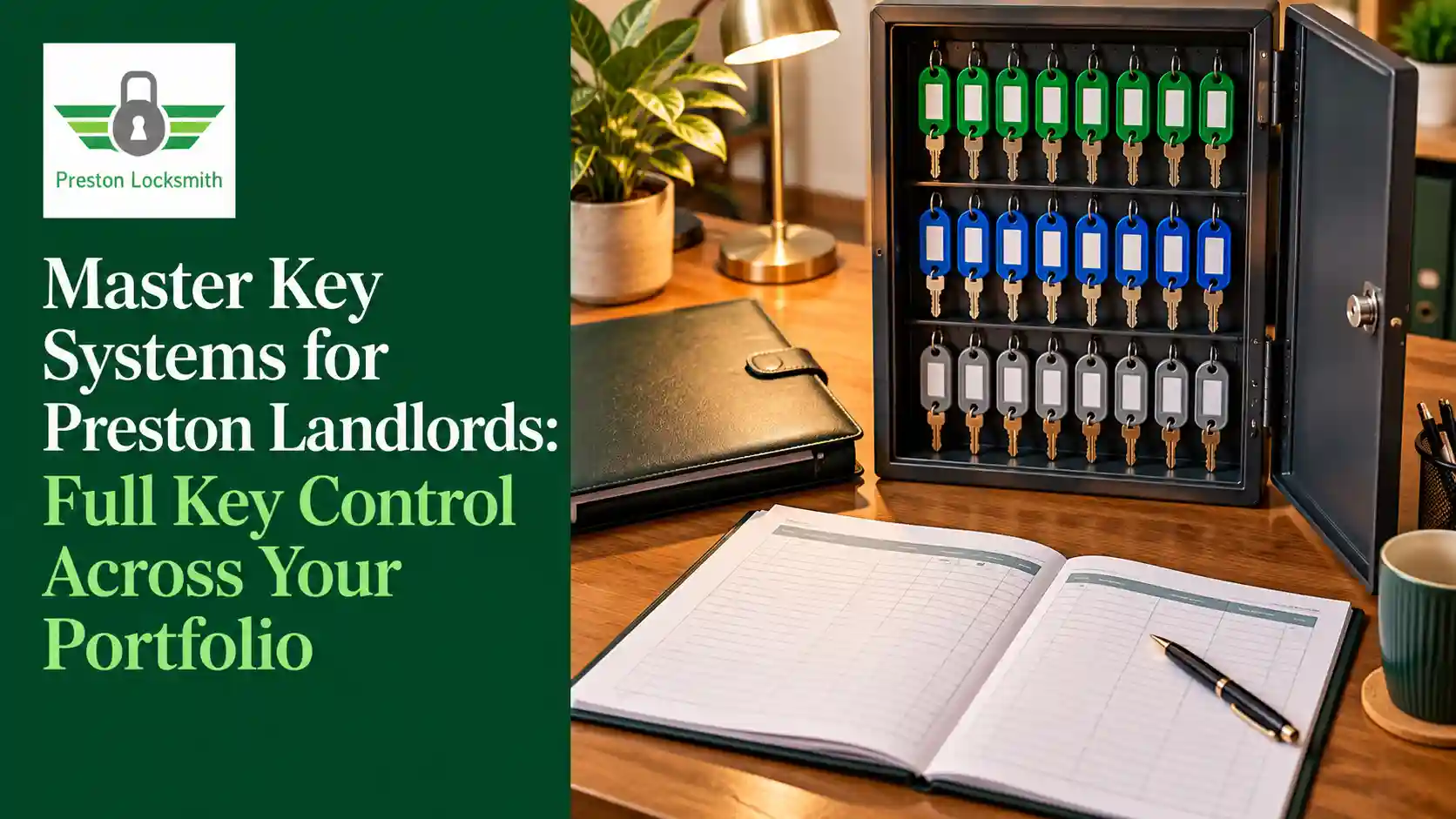
Preston’s rental market is busy, competitive, and heavily trafficked by investors. With 40% of the suburb’s households renting — one of the highest proportions in Melbourne’s inner north — and median house prices holding around $1 million, the suburb has attracted substantial investment buying. Many Preston property owners hold more than one property in the suburb or the broader Darebin area, and property managers here regularly oversee portfolios spanning multiple Preston properties across different streets and housing types.
The operational reality of managing rental properties — the key cutting, the key returns, the coordination between tenants and tradespeople, the emergency access questions — is one of the more persistently time-consuming elements of property management, handled ad-hoc by most landlords. A master key system replaces ad-hoc key management with a designed, documented, controlled system. For a Preston landlord with more than one property, it’s one of the most practical operational improvements available.
The Key Management Problem in a Preston Rental Portfolio
Consider a typical two-property Preston rental scenario across three years. Each property cycles through one to two tenancies per year — the suburb’s renter turnover is meaningful, with the younger professional demographic moving through on shorter tenancies as life circumstances change. Each tenancy involves issuing two to four keys to tenants, possibly a copy to the property manager, and managing the return at lease end.
Over three years, across two properties: six to twelve tenancies, each with two to four keys distributed. Some tenants have copies made for partners, family members, or housemates who joined the tenancy mid-way. Some keys are not returned at lease end — either because the departure is rushed, or because a key is “lost” that was actually kept. The property manager may have rekeyed between some tenancies but not all.
At the end of three years, the key history of the two properties is genuinely unclear. The number of operative copies for either property is unknown. And the question “who could access this property right now?” has no reliable answer.
This is not an unusual scenario — it’s the standard operating state of most small Preston rental portfolios. The standard response is to change the locks when a tenancy ends badly, and to accept the uncertainty otherwise.
A master key system doesn’t eliminate the need for tenancy management, but it changes the scale of the problem: instead of an unknown number of copies with an unknown history, you have a documented system where every key issued is recorded, every access level is defined, and the response to a tenancy ending is a controlled rekey within the system rather than a decision about whether to change the locks.
Pro Tip: A master key system pays off operationally as soon as you’re managing three or more Preston rental properties — the reduction in coordination time and the clarity of the key register quickly offset the setup cost, particularly if your property manager is currently tracking key sets across a portfolio without a documented system.
How a Master Key System Works
The mechanics are based on cross-keying: each lock cylinder in the system is pinned to respond to two distinct keys — the individual key assigned to that specific cylinder, and a master key (or sub-master key) that works across multiple cylinders in the hierarchy. This is achieved through a specific pin configuration within the cylinder. It doesn’t reduce the cylinder’s security against unauthorised entry — the individual key and master key both operate the lock correctly, but no other key does.
For a Preston rental portfolio, the typical three-level hierarchy:
Tenant keys: open only the cylinders for the specific property that tenant occupies — front entry, rear entry, any other external access points keyed to their set. No tenant key works on any other property in the portfolio.
Property manager sub-master key: opens all properties in the portfolio. Enables inspection, maintenance access, and emergency situations without the property manager needing to track individual property key sets. One key, all properties.
Landlord grand master key: also opens all properties, providing a backup to the property manager access. Typically two copies held by the landlord, stored separately.
The restricted keyway: all cylinders in the system use a keyway managed by the system locksmith. Keys cannot be duplicated at a hardware store or key kiosk — only by the registered system locksmith, with written authorisation from the system owner. This is the element that makes the system genuinely controlled rather than just documented.
When a tenant moves out, their specific property cylinder is rekeyed within the system — a new individual key is cut for the new tenant, the sub-master and grand master continue to work, and no other property requires any change. The response to a difficult tenancy end, or a lost key, is contained to the specific property affected.
The Restricted Keyway: Why It Changes the Security Equation
Most residential locks in Melbourne use non-restricted keyways — the cylinder profile that accepts standard key blanks available at every hardware store and supermarket key kiosk. A tenant who has a key can have it copied immediately, for any reason, as many times as they like. A key not returned at lease end is a key that may have copies.
A restricted keyway system is designed around a keyway profile that requires a specific key blank — a blank that is registered to the system and only available through the authorised system locksmith. When a tenant receives keys in a restricted keyway system, they physically cannot have those keys copied at a hardware store, because the blank doesn’t exist there.
For a Preston landlord, this means that the key control established at the system setup is maintained indefinitely: no undocumented copies can exist for any cylinder in the system, the key register accurately reflects every key that operates the system, and a tenant’s claim that they’ve “lost” their key doesn’t create an invisible security exposure for the next tenancy.
Pro Tip: When setting up a master key system for Preston properties, establish a formal key register from day one — a simple log recording which key was issued, to whom, on what date, and any return date. The system’s security relies on this documentation being maintained, and a key register that’s six months out of date provides far less protection than one updated at every tenancy change.
What a Master Key System Setup Involves for Preston Properties
A master key system setup for a Preston rental portfolio is typically a half to full day depending on the number of properties and external entry points. The locksmith visits each property, assesses the existing lock hardware, and either repins the existing cylinders to the master key system configuration (where the cylinder brand and condition are suitable) or replaces the cylinders with new ones in the restricted keyway.
For Preston’s Victorian cottages with original mortice locks: these often need cylinder replacement rather than repinning, as original mortice lock cylinders are typically in non-standard formats. Modern cylinder inserts can be fitted to most vintage mortice lock cases, maintaining the period hardware appearance while providing current-standard security and master key system compatibility.
For Preston’s brick homes with mid-century deadlocks: cylinder condition varies significantly. Many can be repinned into the system; some are worn enough to warrant replacement.
For Preston’s newer apartments and townhouses: typically compatible with standard system cylinders without modification.
Output of the setup: a key register with every key documented, a system diagram showing the access hierarchy, and a set of grand master and sub-master keys issued at registration. All future key requests are processed through the system locksmith against the registered authorisation.
A Bell Street Portfolio: The System in Practice
I was engaged by a Preston landlord who owned three properties — a weatherboard cottage near Bruce Street, a brick home south of Bell Street close to Thornbury, and an apartment unit in a complex on Plenty Road. She’d been self-managing with a spreadsheet of key information for four years and had reached the point where the spreadsheet was less reliable than she needed it to be.
The cottage had its original mortice lock on the front (serviced but the cylinder was worn) and a modern deadlock on the rear. The brick home had two modern deadlocks — front and rear — in good condition for repinning. The apartment required coordination with the building manager for the building entry, with the individual apartment door on a new cylinder in the system.
We set up a three-level system across all three properties. The cottage and brick home cylinder work was completed in a single day. The apartment was done the following week once building manager access was arranged. The landlord received two grand master keys; her property manager received a sub-master. Each tenancy currently in occupation received new individual keys for their specific property. All keys signed for at issue; key register updated.
The landlord has since added a fourth property to the system — a process that took one afternoon of cylinder work and an update to the key register.