
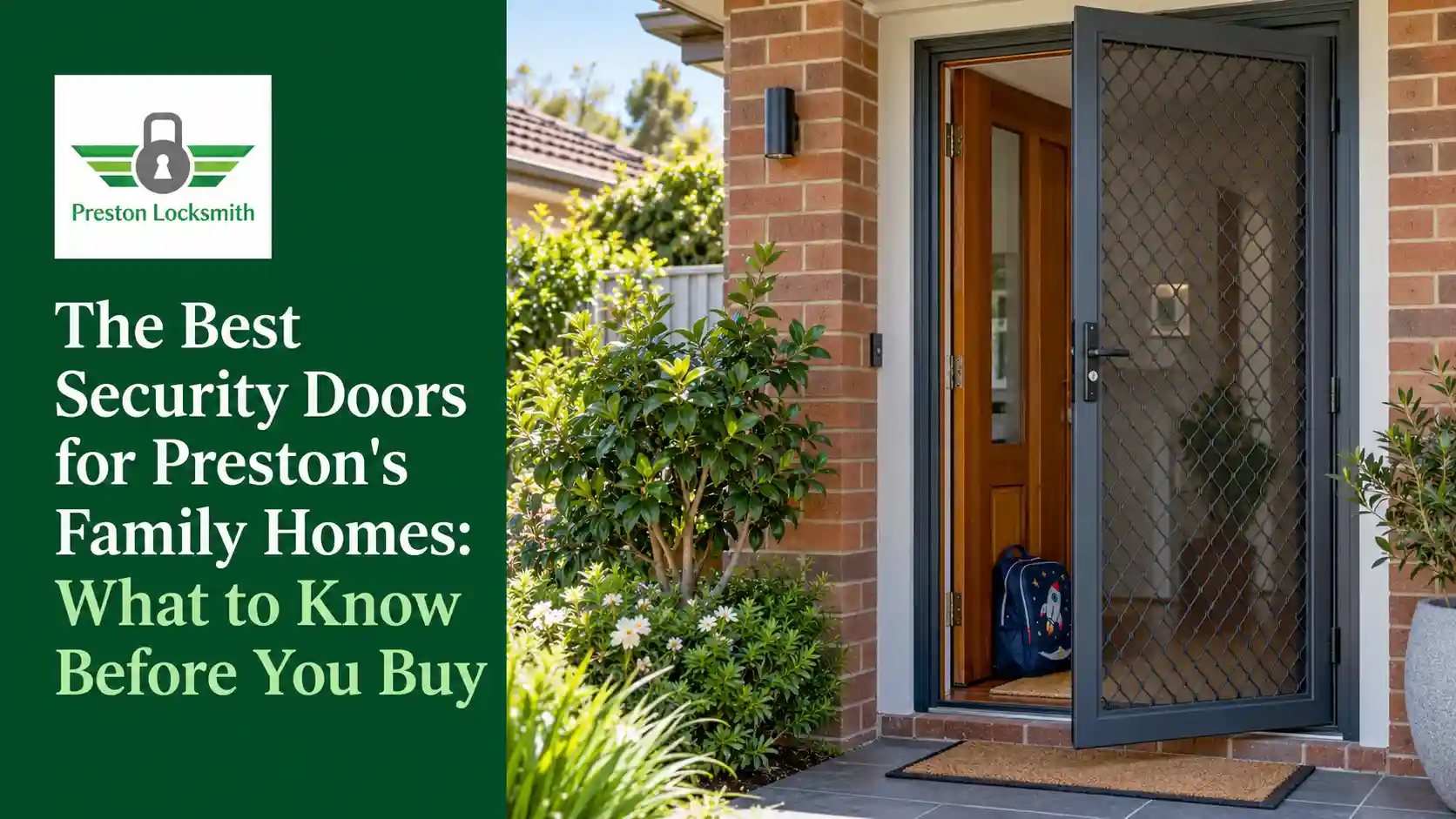
Security doors are one of the most visible security investments a Preston homeowner can make — and also one of the most variable in quality. The range of products marketed as “security doors” or “security screens” in Melbourne covers everything from genuinely tested, graded equipment that provides real resistance to forced entry, to products that look substantial but have not been independently tested to any meaningful standard. Understanding the difference matters, because the reason you’re buying a security door is that it should work when it’s tested by someone who wants in.
Preston gives that question some urgency. The suburb’s property crime data is real and worth knowing: burglary figures in the 350-500 range annually, theft affecting roughly 1 in 10 residents, a crime rate above the Victorian average despite recent year-on-year improvements. The suburb’s mix of family homes — Victorian cottages, post-war brick houses, terrace rows, townhouses — and its proportion of dual-income households creating extended daily empty periods means that a properly selected and installed security door is a worthwhile investment, not a cosmetic one.
The Australian Standard: What the Grading System Means
Security doors and screens in Australia are assessed under AS 5039 (Security Screen Doors and Security Window Screens) and its companion standard AS 5040 (Installation of Security Screen Doors and Window Screens). Products tested to these standards are subjected to knife-shear, impact, jemmy, and pull tests that simulate realistic forced entry attempts, and must pass specific performance thresholds to be rated compliant.
Within the standard, products are graded P1 and P2. P2 is the higher rating and indicates resistance to sustained, tool-assisted forced entry attempts. For a Preston family home’s primary external entries — front door, rear door, any accessible side entry — P2-rated products are the appropriate specification.
Products that are not tested to AS 5039 cannot legitimately make security performance claims, even if they’re described as “security” products in retail and trade marketing. A product description that uses terms like “security-style” or that cites a frame gauge without mentioning AS 5039 compliance should prompt a question about independent testing.
The critical importance of this grading is that it’s the only way to compare security performance between products. A heavy-looking aluminium grille door from one brand and a lighter mesh-style security screen from another may perform at the same grade, or very differently — the frame thickness and aesthetic tells you nothing about performance without the test data.
Pro Tip: Always ask the supplier or installer for the AS 5039 compliance certificate for the specific product being quoted — not a general brand certification, but the tested configuration (frame, mesh/grille, hardware, hinge) that will be installed. A legitimate supplier has this documentation available.
Steel Grille vs Security Mesh: The Main Choice
The two dominant categories of residential security door for Preston homes are steel bar grille doors and security mesh screen doors. Both can be manufactured to AS 5039 standards; the choice between them involves aesthetics, ventilation, visibility, and price.
Steel bar grille doors: the traditional “security door” form — vertical or horizontal steel bars in an aluminium or steel frame, with a deadlock. Heavy, visually substantial, provides strong forced entry resistance. The visibility trade-off is significant: a steel grille door blocks outward visibility from the home (you can’t see who’s on the other side as clearly as through a mesh screen) and reduces natural light. Ventilation through the grille is limited compared to an open mesh. On Preston’s period homes — the Victorian and Edwardian cottages especially — a well-designed steel grille door can complement the heritage aesthetic; poorly chosen ones look like an afterthought.
Security mesh screen doors: the contemporary alternative — a fine welded steel or stainless steel mesh in a frame, with a locking mechanism. When properly manufactured and graded, mesh screen doors offer comparable forced entry resistance to grille doors (the mesh is extremely difficult to cut or punch through) while allowing full outward visibility, good natural light transmission, and effective natural ventilation. The transparent quality makes them popular on Preston’s renovated homes, where the front door presentation matters and a traditional grille door would feel intrusive.
For most Preston family homes, a graded security mesh screen door on the primary external entries — front and rear — is the better fit with the suburb’s housing stock character and renovation aesthetic. Steel grille doors remain appropriate for properties where security prioritisation is paramount over other considerations, or where the property style suits the aesthetic.
Frame and Locking Hardware: Where the Performance Difference Lives
The frame and locking mechanism are as important as the mesh or grille in determining a security door’s actual performance. A P2-rated mesh in an inadequately reinforced frame doesn’t deliver P2-rated performance; the frame is where forced entry actually concentrates force.
Frame material: extruded aluminium frames are standard and appropriate for residential security doors. The minimum appropriate wall thickness for a security door frame is 1.6mm; P2-rated products typically run thicker. Steel frames provide the highest structural rigidity but add weight and are less commonly specified for residential installations.
Hinges: security door hinges should be three-point continuous hinges — running the full height of the door on the hinge side — rather than butt hinges at the top, middle and bottom. Continuous hinges distribute load across the entire hinge edge rather than concentrating it at three points, providing substantially better resistance to the door being pulled or pushed from the hinge side.
Locking: a security screen door is only as secure as its locking hardware. A deadlock rated independently from the screen — ideally a Grade 5 single or double cylinder deadlock, installed in the security door frame at a proper strike — provides the resistance the screen’s structural rating implies. A standard knob lock or privacy latch in a security screen door undermines the security the screen itself provides.
Pro Tip: For a Preston rear entry that combines a security screen door with an existing primary door, confirm that both the screen’s lock and the primary door’s deadlock are operational when the property is unoccupied — a security screen with its deadlock engaged and the inner door deadlocked behind it provides layered resistance that a single lock on either door alone does not.
Preston’s East-West Character Split and What It Means for Security Door Selection
The east-west character difference in Preston is relevant to security door selection. The streets west of High Street — Bruce Street, Gilbert Road, the period weatherboard cottages — tend to have homeowners who are making considered decisions about the aesthetic of their homes, and a security door choice that clashes with a thoughtfully renovated period facade is a real concern. For these properties, a powder-coated security mesh door in a colour that complements the period palette, with solid locking hardware and continuous hinges, is the right balance.
East Preston — particularly the former Housing Commission estate area and the higher-density streets around Plenty Road — has a different context. These properties have often been less comprehensively renovated and may have original lock and door hardware still in place. A security door here is often being added to an entry that needs all-round attention, and the priority is performance rather than aesthetic integration.
For both, a security door is correctly understood as one component of a layered approach: a P2-rated screen door with a Grade 5 deadlock, on an entry with a properly fitted box strike and long screws into the structural jamb, provides real security. The same screen door on a door frame with a shallow face-mounted strike on short screws is significantly less effective.
What the Assessment Found on a Murray Road Property
I was called to a property near Murray Road — a post-war brick home, family with two school-age children, the parents commuting daily leaving the house empty for long working hours. They’d been planning to fit security doors for months and wanted advice on what to buy before committing.
The front entry: a solid brick archway with a timber primary door, no security screen. The rear: a glass louvre panel door — one of the most common lower-security configurations on Preston’s older brick homes, where the louvres can be removed or broken without touching the door frame itself. Two ground-floor windows facing the side passage: awning windows with factory latches only.
We fitted a P2-rated security mesh screen door on the front entry, a P2-rated security grille door on the rear (replacing the louvre door entirely), and key-operated window locks on the two side passage windows. The rear louvre door was the most significant vulnerability on the property — the screen door removed it from consideration as an easy access point. Total job: one and a half days across two visits.
Installation Matters As Much As the Product
A P2-rated security door installed incorrectly doesn’t deliver P2-rated performance. The three most common installation errors that undermine security door performance: insufficient fixing screws in the hinge side (reducing the number of anchor points the hinge resists force through), a strike plate morticed into the lining timber rather than the structural jamb (reducing resistance to frame kickout), and inadequate perimeter sealing that leaves the door frame loose in its opening.
Professional installation with the manufacturer’s specified hardware, fixed into the structural elements of the door opening rather than just the lining, is the standard the door’s test rating was achieved to. A security door fitted by a competent installer to that standard will perform as rated. One fitted by a general handyperson with whatever screws were to hand may not — and the difference isn’t visible until the door is tested by someone with different intentions.